Research · Visual analytics
Machine Unlearning Comparator
An interactive visual analytics system for comparing how machine-unlearning methods forget data while preserving model utility.- React
- D3.js
- Zustand


Overview
Making unlearning tradeoffs visible across accuracy, efficiency, and privacy.
Machine unlearning aims to remove the influence of specific training data without retraining a model from scratch. In practice, that goal is hard to evaluate: a method can forget targeted samples, damage retain-set utility, leak membership signal under attack, or simply cost too much to run. Comparing methods therefore means reading tradeoffs across accuracy, efficiency, and privacy rather than ranking a single score.
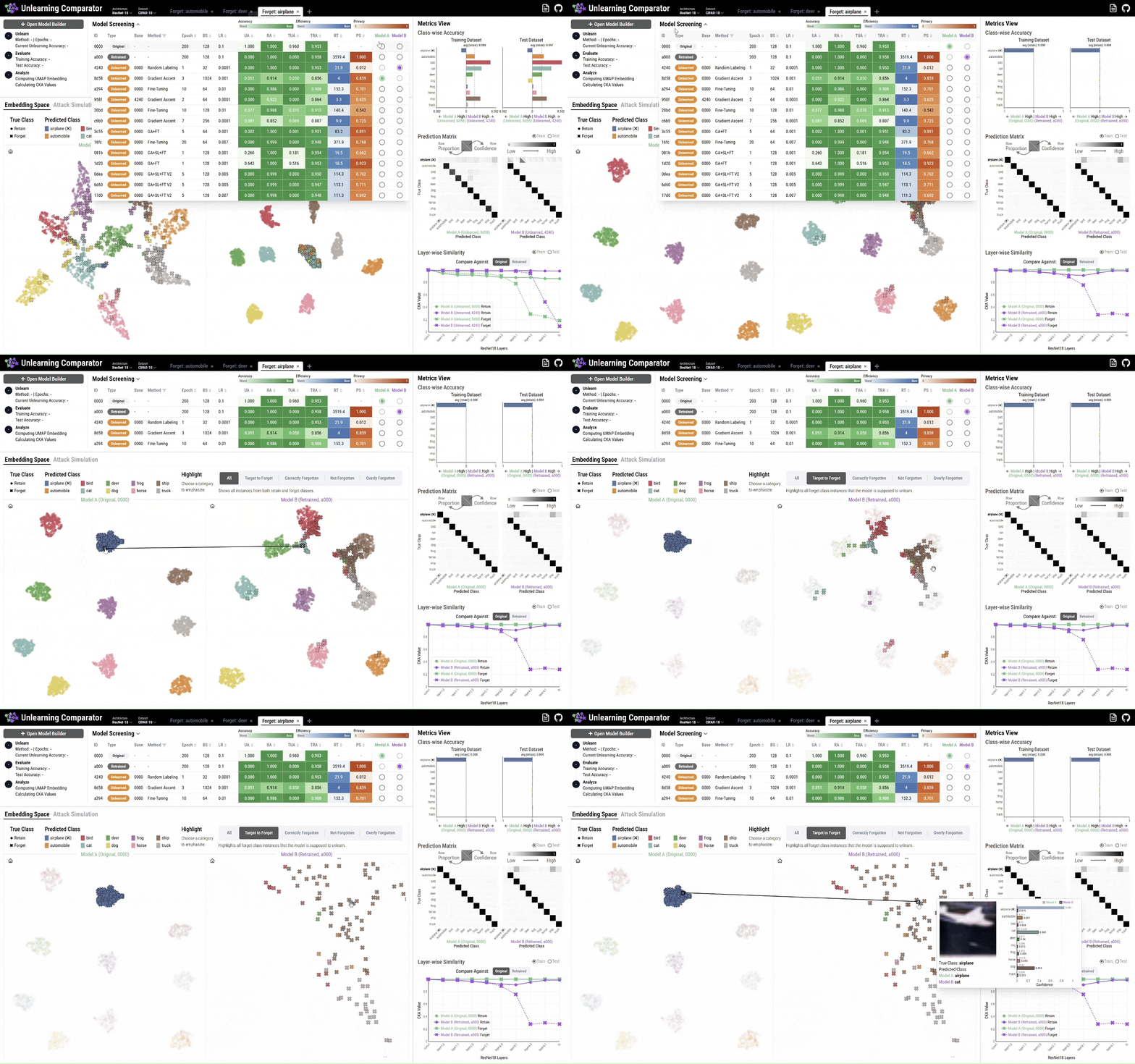
Machine Unlearning Comparator is a web-based visual analytics system designed for that comparative workflow. Researchers move through four stages—Build, Screen, Contrast, and Attack—to configure experiments, scan high-level outcomes, inspect model behavior in detail, and audit residual privacy risk. Linked views connect class-level metrics, prediction matrices, embedding spaces, and layer-wise similarity so analysts can jump from overall method performance to individual samples and representation changes.
The system ships with common unlearning baselines such as Fine-Tuning, Gradient Ascent, Random Labeling, SCRUB, and SalUn, and supports custom methods through a Python registration hook. Interactive Membership Inference Attack views help verify whether forgotten data still leaves detectable traces. The project was developed at the Intelligent Data Computing Lab at SKKU and published in IEEE TVCG 2026.
Contribution
What I worked on
- Built interactive comparison surfaces that let researchers move between method-level outcomes and instance-level evidence without breaking context.
- Reduced scatterplot interaction latency to p95 ≤ 11 ms at 2,000 points with imperative D3 updates and careful memoization for dense embedding exploration.
- Cut React rerenders by about 30% by migrating shared state from Context API to selector-based Zustand subscriptions across linked views.
- Iterated interaction workflows through three Figma user-study rounds and contributed to the open-source platform published in IEEE TVCG.